| |
|
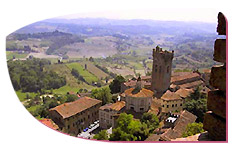
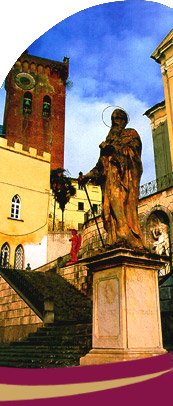
San Miniato, medieval village placed between Pisa
and Florence...
|
 |
| |
 |
San Miniato was an Etruscan and then Roman
land site.
Archaeological digs are testimony to a 3rd century
BC necroplis located in present day Fontevivo and a
Roman villa in present day Antonini. Written reports
can be found in the Archaeological Museum of Florence
and the Civic Museum. The original city center came
to be in the VIII century when 17 Longobardi's,
according to the original documents from 713 BC conserved
in the Arcivescovile Archives of Lucca, built a church
dedicated to Miniato the Martyr.
A story like this couldn't have not left such
a relevant artisitic and architectural heritage. Starting
from the central Piazza del Popolo one will find the
14th century church of San Domenico, home to the Sant'Anselmo
frescoes. One of the most noted frescoes here is that
of Longhi and Berenson given to Masolino of Panicale,
a funerary monument by Donatello.
To the left of the facade, there is an mysterious
road called Via Angelica which is a underground passage
way from the old city walls to the countryside. On
the right you'll see the convent with its cloisters
that were confiscated and then re-opened by the napoleanic
administration where its main Historical Archive is
one of the richest in Tuscany with over 100,000 documents
from the 1200's.
|
| |
|
|
Continuing on one will find many examples of renasisance
architecture, one of which is the Palazzo Formichini,
headquarters for the Cassa di Risparmio collection
(with works by artists such as Guercino, Lorenzo di
Bicci, Jacopo del Sellaio, Cigoli and Givanbattista
Naldini), and especially Palazzo Grifoni built in 1555
by Giuliano di Baccio d'Agnolo. Down in the valley
past the octogonal church of the Santissima Annunziata,
where the relics of Santa Dorotea have been conserved,
you will find the Santa Chiara monastery, another center
of the museum system. Here there are artworks from
such artists as Cigoli, Deodato Orlandi, Jacopo Chimenti
and school works from the 15th century.
|
| |
|
In the opposite direction leaving from San
Domenico and going upwards towards the old
castle center, past the Roffia Palazzo (this also
being of Giuliano di Baccio d'Agnolo), is the Porta
Toppariorum. This door gave access to the antique
defense center. Inside of the door, the Casatorre
degli Stipendiari, Federiciana art, was home to the
military contingency. Past this one can see the scenographic
Piazza del Seminario, enclosed by the other impending
medieval door.
From the plaza, by use of a triple entrance system,
you can reach the Piazza del Duomo.
|
 |
| |
|
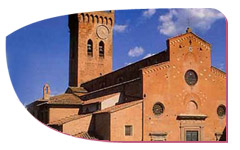
The rest of the tower and Imperial Palazzo are found
here, dating back to the 11th century, which was home
to a good four German emperors: Ottone I di Sassonia
in 1962, Federico Barbarossa in 1167 and 1178, Ottone
IV in 1209 and Federico II of Svevia in 1218, 1224
and 1240. Just opposite the Palazzo Vescovile (Bishop's
plaza) the Duomo was erected in the 14th century on
top of 3 preexisting buildings. In front of the Duomo
there is an antique pieve of Santa Maria from 1100.
Next to the Diocesan Museum of
Sacred Art there is
a Verrocchian redeemer and a crucifixion done by Filippino
Lippi. Behind this, you'll find the tower of
Matilde erected in 1100 and then made part of the duomo
as the bell tower.
|
| |
|
 |
|
|
|
|